In SiC and IGBT power modules the die attach layer is the main heat path and the main reliability limit. A SiC study from an automotive power supplier notes that tin-based solder is not suitable above about 150 °C because of its low melting point and creep, and that sintered silver, with a melting point of about 962 °C, shows roughly one order of magnitude less creep than solder at 150 °C and 10 MPa [1]. That is why sintering is replacing solder on SiC dies.
The process flow, and where the bonder sits
A typical pressure-assisted flow is the same across papers. Silver paste is stencil or screen printed on the substrate, dried to remove solvent, the die is placed on the dry paste by automatic pick and place, and then the die is pressed at temperature for a set time [1][4]. In some flows the die is only pre-bonded to the dry paste and the press happens later in a separate sintering press [4]. The bonder therefore owns step three: the die has to land in the right place on a soft, dried layer without smearing it, before any pressure is applied.
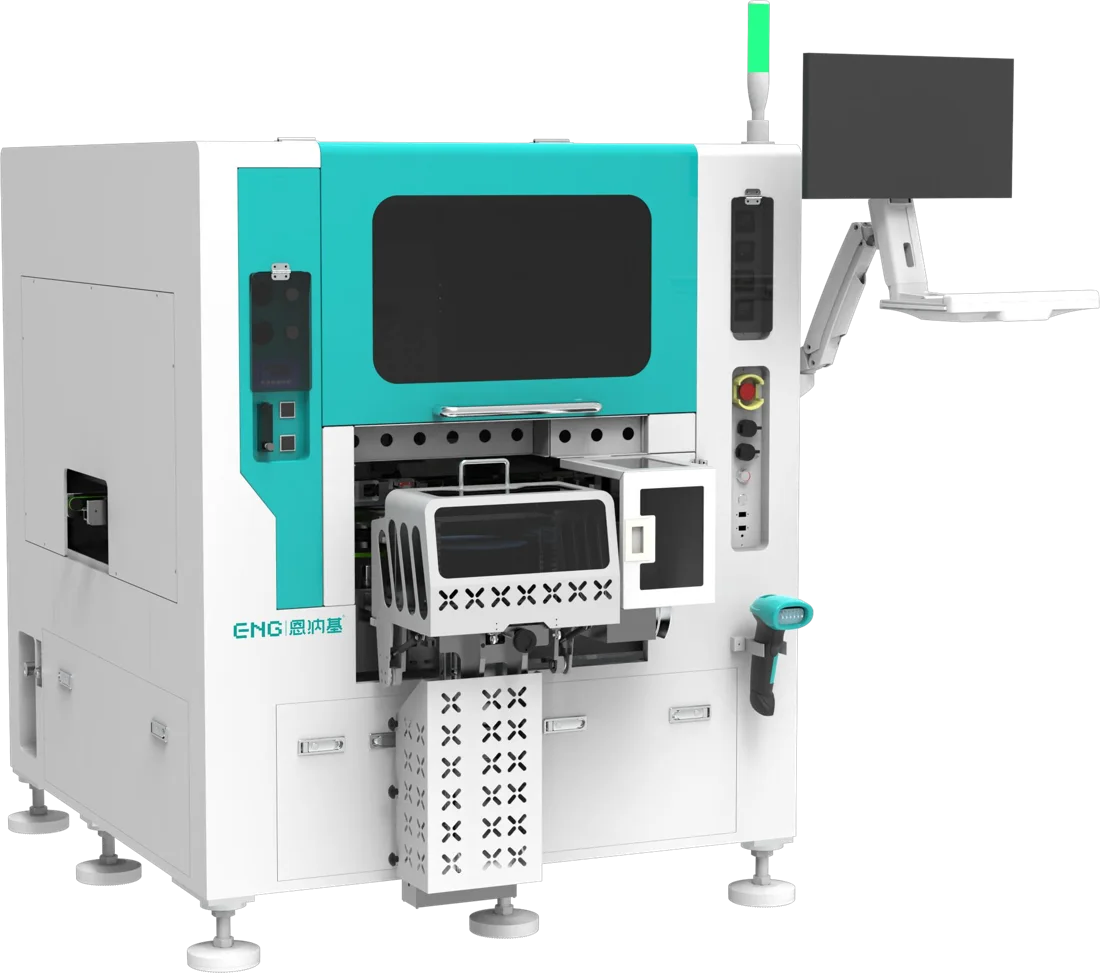
That is the role of a pre-sintering die bonder such as the M18 Ag. It places SiC die for TPAK, HPD and DCM modules with heated bond heads and a pre-heated table, and supports silver paste, silver film and nano-copper processes. The related SiC sintering die attach page lists the full setup.
| Topic | What the sources say | What it means for the bonder | M18 Ag data point |
|---|---|---|---|
| Process flow | Paste is printed, dried, the chip is placed on the dry paste, then pressed at temperature [1][4] | Placement is a separate step before the press | Pre-sintering die bonder for paste and film |
| Pressure | One SiC study compared 10 to 30 MPa for 2 min at 200 to 250 °C; the highest pressure gave 8% voids and the shortest cracks [1] | Pressure sits in the sintering press; the bonder must not damage the paste layer | Heated head force 10 to 300 N ±10% |
| Low pressure route | Paste plus film reached over 40 MPa shear strength at 5 to 10 MPa in 3 to 5 min [2] | Film and paste both need accurate, repeatable placement | Silver paste and silver film supported |
| Large area | 250 °C, 15 MPa, 5 min recommended for substrate to baseplate; open-face drying [3] | Different step from die attach; do not mix the two specs | Die size 1 to 20 mm |
| Paste state at placement | Paste is dried before the die is placed, for 30 to 60 min in one assembly flow [4] | Placement happens on a dried, soft layer | 300 ℃ heads and table, inert-gas protection |
| Placement accuracy | Not specified in these sources; agree it against your pad layout | Vision on die and substrate, per-die traceability | ±10 μm @3σ XY |
Bracketed numbers refer to the Sources list. Published values come from different materials, die sizes and presses, so use them as references for your own trials. M18 Ag values are manufacturer data.
Pressure and porosity
The same study compared three pressures between 10 and 30 MPa, each applied for 2 minutes at a temperature between 200 and 250 °C. Porosity fell as pressure rose: 20% voids at the lowest pressure, 12% at the middle value and 8% at the highest. After 3000 liquid thermal shocks, crack length in the sintered layer was 0.61 and 0.46 times the lowest-pressure result for the middle and highest pressures, so the authors set the process at the highest pressure [1]. They also note a trade-off: a higher sinter layer modulus raises thermal stress from the expansion mismatch between chip, joint and substrate [1].
A 2025 Virginia Tech thesis tackles the other side of the same problem. Traditional sintering uses long times and high auxiliary pressure, which restricts throughput and can damage brittle chips. Its Paste+Film method reached shear strength above 40 MPa with only 5 to 10 MPa and 3 to 5 minutes, and cut the overall sintering time by about 75% on a double-sided cooled SiC MOSFET half-bridge module [2]. For a bonder this matters: film and paste both have to be placed with the same care.
Large-area sintering is a different job
Sintering a whole substrate to a baseplate is not die attach. A 2024 study of areas above 2400 mm² recommends open-face convective drying, 250 °C, 15 MPa and a 5 minute hold for that joint [3]. If a supplier quotes one pressure for both steps, ask which step it applies to.
What the placement step must control
- Temperature at placement. M18 Ag uses heated heads and a heated work table at up to 300 ℃, with a pre-heat zone on the Ag Pro, so dried paste and film see a stable temperature.
- Oxidation. Inert-gas protection is built in.
- Force. The heated head runs 10 to 300 N ±10% on M18 Ag, and 0.3 to 300 N ±10% on M18 Ag Pro.
- Accuracy. ±10 μm @3σ XY, ±0.5° @3σ angle on M18 Ag and ±0.1° @3σ on Ag Pro.
- Traceability. Wafer, DBC and AMB barcode traceability is optional, useful for automotive lots.
- Throughput. Manufacturer data lists UPH of at least 1,500 for paste on M18 Ag, and 1,000 for film (stamp 200 ms, bond 800 ms) on Ag Pro. Ask for UPH on your own die and process.
IGBT and other power dies
Published IGBT work uses the same flow with silver sinter film as well as paste [4]. If your product uses Si IGBT or diode die, the same placement checks apply. GaN is not listed in the ENG material we hold for M18 Ag, so we do not claim support for it; send your die and substrate and we will ask ENG.
How to evaluate a pre-sintering bonder
- Send the die size, metallization, substrate (DBC or AMB) and paste or film type.
- Ask for placement results measured after bonding on your substrate, not on a glass test part.
- Check the force range against your thinnest die, since SiC die are brittle.
- Ask for UPH on your own process, including film stamp time.
- Agree the void and shear acceptance method before the trial, usually acoustic microscopy and shear test after the press.
What this does not tell you
- The cited pressures and temperatures belong to specific pastes and presses, not to any bonder.
- A bonder does not set final porosity; the press and paste chemistry do.
- These sources do not compare equipment makes, and this article does not either.
Sources
- Calabretta et al., Silver Sintering for Silicon Carbide Die Attach: Process Optimization and Structural Modeling, Applied Sciences 2021, 11(15), 7012
- Chen, Low Pressure and Short-Time Silver-Sintering for Power Modules, Virginia Tech thesis (2025)
- Xue et al., High-Pressure-Assisted Large-Area (>2400 mm²) Sintered-Silver Substrate Bonding for SiC Power Module Packaging, Materials 2024, 17(8), 1911
- Wang et al., A new SiC power module assembly based on silver sintering bonding, EPE 2023 (University of Twente)